Wednesday, July 29, 2020

Ioannis Sicuya


 Ioannis Sicuya: The undeniable urge to create

By Hannah Jo Uy

For Ioannis Sicuya, art serves the fundamental purpose of satisfying his undeniable urge to create. An urge, primal in nature, that burns within his soul. “I like the idea that I have the capacity to create something out of anything,” Sicuya shared, “and it matters little to me whether I'm doing an artwork for an exhibition or a cabinet for our house.”

Initially considered an assemblage artist, Sicuya said that early on he gravitated towards the works of Joseph Cornell and was heavily inspired by the weirdly wonderful books of Nick Bantoc. “Locally, I admire the works of Alwin Reamillo, Norberto Roldan and Sicuya’s evolution as an artist, however, is not only confined to his medium. It is revealed in his artistic approach as well. While lauded for his technical skill and expertise, gained from his rigorous studies in art school, Sicuya’s training in theory, while imbuing his work with a strong sense of sophistication and finesse, led works that were deeply intellectual. “I developed a mindset that an artist has to know his artwork front and back even before he begins the actual process of creating it,” he said. “This approach has lead me to overthinking my initial concepts and causing a sort of creative paralysis for fear that my work would not be "logical" from a conceptual standpoint. It took me a while before I realized that, one, this isn’t necessarily true for every art practice, and two, it does not fit my natural tendencies as far as my creative process is concerned.”

It was during this time that Sicuya aimed to strike the balance between planned, and unplanned aspects of his work, reveling in the process. “Once I know the imagery that I would like to execute, I start production even if the concept is not 100% whole in my head,” he said. “I partly let the work tell me where to go next. It even became somewhat of a signal for me that I made a wrong turn somewhere when I am stressing out and overthinking during the conceptualization stage.”

This process paved the way for Sicuya’s latest exhibition, “Encroaching Behavior”, recently showcased at Eskinita Gallery. Featuring several pieces that are awe-inspiring for their meticulous details, the collection reflects Sicuya’s long-standing fascination for the natural world, particularly the variety of textures and forms it possesses, which he has been substantially incorporating into his works.

Molded by his very hands from epoxy, Sicuya admitted to favouring the medium, as of late and being drawn to its peculiar properties. “I like the fact that there are certain manipulation processes that can only be used at certain times during its curing period,” he said, adding that being so accessible, as it is more readily available in large hardware stores compared to polymer resin, and being more odour-friendly, is an added bonus.

As far as his process goes, Sicuya said that he is currently more concerned with the imagery and the forms that he wants to create than the message or the narrative that he has to relay. “In this process the concerns or the themes of an exhibition I’m working on are in flux up until I have produced a substantial body of work that points to a more concrete direction which the exhibition can lead up to.”

With regard to his latest collection, Sicuya drew parallels between the termites that infected his home, with the similarly destructive nature of human beings and our impact on the environment. The seed of the idea was cultivated following his contemplations and observations on industrialization—a subject of particular interest following reports that agrarian lands surrounding the artist’s home were slowly being converted into a residential subdivision.

“I arrived at this conclusion simply because of my observation of the consequences of the actions of both species,” Sicuya said, “and for me, destructive does not directly equate to a negative attribute. Nature, and in fact the entire universe, undergoes entropy that is neutral of any moral classification. However, I am also of the position that as a sentient species, we humans can choose not to be destructive, not only for the sake of the planet but, to put it bluntly, for our own self-preservation.”

Jeff Salon

A Touch of the Past

How Jeff Salon’s art challenges today’s generation

October 8, 2018  /  C-2

Text by Hannah Jo Uy

As an artist, Jeff Salon has one goal: to channel his in­nermost being into mind-engaging visuals that com­municate the wisdom of the past and its relevance to the present. All this, Salon reveals, is an effort to cultivate a clear picture of how we, as individu­als, can make a difference.

Heavily influenced by a number of genres, he drew upon core elements from classical and modern paintings, as well as from realism, social realism, and surrealism, developing a distinct aesthetic style that serves as a plat­form for his passionate socio-political commentaries. Through his brush, he discusses everything from war and nature to children’s welfare and the value of virtue, all “with a touch of the past and a touch of the present.”

Salon described his creative ap­proach as both spontaneous and me­thodical. “Anything goes,” he says. “I can express all I want, allowing my­self to create a world that no one has ever been to, where I can dig deep into my inner feelings. In Filipino, we call it hugot or may pinag-huhu­gutan.”

Everything has a beginning. Ev­erything comes from somewhere, Salon says, and it is this deep ap­preciation of the past that pushes him to travel back in time, engaging in imagined conversations with his­torical figures. As he draws lessons from these encounters, Salon pieces together a cohesive narrative.

This is evident in his latest exhib­it, “Battle in the Clouds,” showcased at the Art Verite Gallery. The title is self-explanatory, Salon says, likening the human mind to the clouds. “Its shape, color, mood, direction, speed, motion, and temperature are con­stantly changing,” he explains. “For­ever experiencing a battle within, the outcome uncertain, because the end result will depend if you want to lose or win every battle in life.” Indeed, his artworks are teeming with sym­bolism and archetypal characters heralded for their virtue, all reflective of his philosophy in life and what it means to him to live well.

In Days of Glory, he presents a “young boy flying a paper airplane charging with solid bravery and wis­dom, boldly stepping forward into the future, spiritually shielded and guided by the historical bravery of the young general Gregorio Del Pilar and the soldiers of Tirad Pass.” The direction of the clouds and the wind naturally guide the young boy’s hope, says Salon, adding that this is symbol­ized by the paper airplane. “Gregorio Del Pilar serves as an inspiration for the boy to be strong like the soldiers, have eagle vision, muster courage, and be the next leader—the hope of the future generation,” he says.

In The Conquerer, Salon tackles the alpha male figure, the symbol of strength and courage, flying above challenges. In the painting, the clouds allude to the traits of a dreamer.

In A Sense of Wonder, we are in­troduced to a little girl in celebration of growth, abundance, and fertility, while in Beast Mode, Salon delves into how we are often our own worst enemy. “When the clouds are hazy and dark, be bold and brave to con­tinue the fight,” he says, describing the ethos behind the painting. “Re­lease all the negativity, release the beast inside you, and try to break free from all the evil that surrounds you. This also symbolizes the adrenalin rush you need to face all challenges— to be the best of the best.”

The Burning Man is a particu­larly personal piece. “I was de­pressed,” he re­calls, “and I con­verted that nega­tive energy into a positive one by understand­ing the sacrifices of past heroes.” He stresses that one must learn how to convert w e a k n e s s e s into strengths. “Instead of be­ing burned by the fire, be that spark of hope that leads oth­ers to a brighter future, just like how heroes sacrificed themselves for the country,” he says.

For Salon, critics are nothing more than background noise in his pursuits to express his philosophy and improve his craft. “Time is irre­versible, but constant action toward a goal leads to evolution, even if one may not notice it,” he said. As he spills his soul onto the canvas, Salon shares his hope for audiences to be left with “solutions and resolutions" to contribute to Philippine history.

“Our heroes risked their lives for today’s people,” he asks, “what can we offer for the next generation? Life and death are facts. Everyone will die. So make the most out of life.”

Van Tuico


In Celebration of Urban Chaos
Van Tuico’s art is under construction

May 29, 2017 
Text by Hannah Jo Uy

Van Tuico doesn’t shy away from city life. In fact, for the versatile artist, urban chaos is a welcome sight. He doesn’t long for faraway places and romantic idyll. Instead he finds beauty in the overlooked and disregarded components that make up the world we live in today. With a truly creative eye, he unleashes the potential of these everyday objects through his witty three-dimensional artworks. Indeed his latest exhibit, “Under Construction,” recently showcased at the Vinyl on Vinyl Gallery, embodies the unique perspective that distinguishes him from other artists.

Van Tuico’s early exposure to the art scene was when a friend working as an assistant for Cesar Legaspi introduced him to the master’s works. He remembers these early days with fondness, describing the feeling of privilege that he had in being able to visit Legaspi’s studio. Coupled with the invitations from friends for the art exhibitions at galleries across the city, Tuico says that this “opened his eyes to the world of art.” But the turning point didn’t happen until 2004, when in the midst of pursuing his medical degree, he began painting instead. He credits the late exposure, however, as greater motivation. At that point, he said, he was wiser and his perspective has broadened to have a deeper appreciation of art.

Painfully shy, Van Tuico shared that his foray into art was driven by his desire to express himself and honor the uniqueness of his internal dialogue: “For me, creating art full time is a step of faith. I am a person who is sorely lacking in communication skills and have difficulty in expressing thoughts. Most of the time [I’m] quiet, I don’t really mingle with people and, sometimes as a result, [I am] misunderstood. Art made a way for me to express myself. It made a way for me to talk in a different form…and have fun and learn in the process.”

In “Under Construction,” his platform of expression has taken on bolder forms to encapsulate the spirit of urban chaos. “The show is about observation of things around us,” Tuico narrates. “How development takes place under our noses. It is how materials are scattered, ruined, and somehow exposed.”

Tuico breathes life into roads, walls, doors, sidewalks, skyscrapers, and construction sites, making these stark and otherwise cold materials into striking commentaries on the prevailing issues of the modern world. From his keen observations during walks and drives, he was taken by the endless development projects that seem to be popping up around the city. He would observe the city’s landscape engulfed in endless projects and the increasingly congested skyline and chronicle these architectural and economic undertakings.

“We are a developing country,” he says. “It’s nice to see progress. The pieces in the show are somehow meant to take you back, bringing you to familiar places or probably places you have never been to. It’s about how things are connected, and also how things fall apart. Most important, it’s about how we interact with things around us.”

For the show, Tuico showcases his distinct ability to manipulate concrete, cement, and steel. The collection serves as a significant departure from his early creations, which featured mostly oils and acrylics. The move to incorporate these rough subject matters came naturally, as he began to incorporate gravel and other found objects before graduating to cement and steel. “There’s always a fascination with cement as a medium,” he says. “Maybe because of the color, rigidity, longevity, and toughness.”

Marking the first time Tuico is unveiling an installation piece, the space that he occupies showcases bolder ideas he aims to bring to life. This new dimension was largely driven by his welcoming attitude to utilising unexpected materials coupled by endless hours on research.

“I spend so much time on research, which is important to me,” he says. “I’m always on the look-out for interesting material in hardware stores, junk shops, and abandoned places. But now, I let the material find me. Once you’re in the jungle (or the junk shop), your senses become more sensitive.”

Tuico uses his time gathering materials and refining his aesthetic concepts as a means of reflection, soaking in these elements and their textures, whether they are walls, rocks, stones, or discarded wood. “I admire how they are exposed, ruined, weathered, eroded, worn, and torn—the imperfections,” he says. “They remind me of the intricacies of life and how we are tested through time. It develops character. Also, getting materials we usually don’t even bother with, it’s nice to bring them back to life or take notice of them. I’m always on the side of the underdog.”

At the heart of the matter, Tuico uses these materials as a metaphor and as an important reminder that we, as humans, are always in a state of constant evolution. Tuico sums up his creative philosophy by what he calls the three Rs: React, Relax, and Reflect. “My aim in making art,” he says, “is to heal, calm, soothe, and reflect on life itself.”

Jonathan Dangue


Going with the flow 
Jonathan Dangue

August 20, 2018 / C-3 
Text by Hannah Jo Uy 


“If I have questions in life, my art provides the answers.” For Jonathan Dangue, cre-ativity is the natural flow of energy pulsating through an artist. “Creativity came from a meditative state of mind that answer questions that the artist can’t explain,” he said. Indeed for Dangue, the artistic process is essentially an untangling of psychic blockages, peeling back layers of doubt, fear, and insecurity—moving towards positivity and paving the way for peace. 

Spontaneous and unplanned, these are the two words that Dangue used to describe his process, which is a nota¬ble departure from his practice as an architect. In architecture, one has to plan everything before finalizing a de¬sign. In art, Dangue surrenders him¬self to his impulses, and contemplates upon its meaning after. “My works are a self-reflection of my current status,” he said. “I treat myself as a child, like playing with wires/rods and sheets. Just like crumpling of a piece of paper. It transfers my energy to the materi¬als through my hands, and leaving se¬cret messages which give life and soul to each piece.” 

This refreshing positivity took cen¬tre stage in Dangue’s sixth solo exhibi¬tion. “Good Catch of Crabs” on display at the Art Verite Gallery. Presenting 88 hand-wrought brass sculptures, the artist challenges the so-called “crab mentality” often associated with mod¬ern Filipino society, wherein people pull others down for the sake of their own interests. “I want to change that perspective,” he explained. “Instead I associated it with the Chinese culture, which looks at the crab as an icon for prosperity and success.” 

Drawing inspiration from the peo¬ple that cared for him—family, friends, and acquaintances, Dangue attacks the misconception towards crabs emphasizing instead their positive at¬tributes. For Dangue this serves as a microcosm of the struggles we en¬counter in our everyday lives, stress¬ing that focusing on negativity will only breed more of the same. Through his art, he prescribes positive thinking and a good mindset highlighting the miracles that hope can provide. 

With this he fleshes out the sym¬bolic characteristics of the crab, with sheets as the shells and rods as claws in the move to mimic it. The thickness of the shell that protects them from harm to the claws, he added signifies our ability to overcome and triumph over our struggles and defend our¬selves from harm. 

This, Dangue explained is why he baptized this show “Good Catch,” speaking on the desirability that the name connotes. A good catch, he said is not perfect. Through his work, Dan¬gue implored viewers to look at expe¬rience objectively, as neither bad nor good but rather a tool for learning in the move forward. Above all, Dangue celebrated the inherent power of the human beings to make their own reality by shifting perspectives and looking towards the positive aspects of the situation. “Learning this can help us a lot,” he said. “For example, what do we often remember? Isn’t it bad experiences or failures? We learn from them more than from our suc¬cess. It can give us a broader picture of life and develop appreciate all as-pects of our lives, bad or good. Rain cannot be created without the heat of the sun. Gold cannot be gold without the process of high temperature. Coal cannot be diamond without the billion years of process from heat and chemi¬cal process.” 

Using art to chronicle important life lessons was not only confined to concept and design, Dangue had a similar approach when it came to choosing a medium. “Brass as a met¬al is heavy but malleable,” he said. “It can be manipulated easily by hand. Just like the typical life of a person, it’s hard but can be controlled. We can shift and change our own destiny.” Favoring the golden brass metal, for its rustic and timeless look—a meta¬phorical of the wear and tear in our own lives, Dangue admitted that as¬sembling metal requires the use of force and heat through welding. 

Dangue continues to challenge himself, shifting from his architectural and artistic roots towards green and sustainable creations. “I would also like to avoid this kind of option and pre¬fer to bend or clip the metal to lock it in place,” he said. “No welding mean¬ing less electricity, no paints meaning no volatile organic compound on my works that can harm people when they small it. It is brass and brass is anti-bacterial, non-ferrous metal. That is what we can call green or sustainable sculpture, less toxic and no harm to environment.” Dangue is pushing the envelope further, as he looks to future projects that he hopes will see stron¬ger integration of bamboo material, revealing the environmental advocacy strengthening his artistic impression as he looks toward more sustainable avenues of creation. “It’s just a matter of technology, on how you make bam¬boo act like metals,” he said. “Bam¬boo is also a green material that can be harvested in our country. If we can make block of wood bamboo to make sculptures or building materials that can replace concrete, metals, and oth¬er nonrenewable materials and then we are good.” 

Essentially, Dangue said, as an art¬ist a true source of joy is people from all walks of life appreciating his works as an extension of their own intimate human experience. “Through this,” he said. “It shows that we may share a mutual connection.”

Rick Hernandez


Rick Hernandez: Tabula Rasa

Text by Hannah Jo Uy

The theory of tabula rasa, Latin for ‘blank slate,’ refers to the unsullied mind before social indoctrination and has been tackled by deep thinkers such as Aristotle and Persian philosopher Avicenna who referred to it as “pure potentiality.” This idea of pure potentiality is what has driven artist Rick Hernandez to consciously reboot his mind for it to be an empty vessel that will be open to receiving the boundless possibilities that exists in the horizon. An appreciation for the inconstancy that marks life itself fuels the artist. Loyal to only the ephemeral ideas that captures his consciousness, Rick opts to break free from the safe confines of a set style and instead let his hands materialize the latest internal musings that have consumed him. “I think my art throws in more questions than answers,” Rick admits, “Questions even I can’t answer. I think that's what unpredictability does to you.”

The willingness to be a beginner time and time again has injected the works of Rick Hernandez with a freshness and a sense of childlike wonder. This is most especially evident in his recent exhibit entitled ‘Table Drawings’ at The Art Alley which will be on display from November 14 to 30, 2015.

In ‘Table Drawings’, Rick opted to use gouache as a creative throwback to the first medium that initiated him into the art world as it brings back fond memories of his college days when he first aimed to familiarize himself with the challenging paint variant. Drawn to the wild characteristic of the medium, which mirrors the capricious and charming nature of his own works, Rick created a collection imbibed with subtle and earthy hues strongly imitating the worn pages of old books and journals stained by intimacy and the passage of time.

The medium greatly complimented the subject matter of flora and fauna which has been a source of inspiration for the artist even at a young age. The meticulous and breathtaking aesthetics of botanical, zoological field notes and other antiquarian imagery have always attracted Rick who was fascinated by its unassuming visual quality. Rick has imbibed his work with the same quality inspired by the distinctive flowers and greenery he saw in Malaysia during his participation at the 2014 Langkawi Art Biennale. The images struck him so that upon returning he delved into his own research which became the basis for his current exhibit.

Although retaining a loose and relaxed characteristic, Rick has always managed to guide his work with a firm hand into a unique direction. His willingness to venture to new techniques has managed to stay within the boundaries of whatever concept he is aiming to explore, which provides it with a notable balance of structure and chaos.

An Advertising graduate from the Technological University of the Philippines, Rick had initially viewed painting as nothing more than a subject requirement. After college, Rick got his first job working  as a graphic designer for Ross Capili where he was exposed to the outstanding artists within the local art scene. “Ross has been a great influence in my art, he was the one who pushed me to paint,” says Rick, “He has a way of teaching you how to do things without dictating you. He made me believe that I can do all these things that I'm doing now. More than a mentor he's like a father to me.”

As an artist, Rick is determined to outfit a concept with the most fitting medium that will serve the purpose of his message. “I have this Oscar Wilde quote in my head that goes ‘continuity is the last refuge of the unimaginative,’" Rick confesses, “I'm consistently inconsistent and I’m always trying out new things.” The effect is a truly dynamic and widely diverse artistic portfolio that is set to enthrall viewers for years to come.

Tuesday, July 28, 2020

Ronald Jeresano


Using Social Realist-Inspired Images, Jeresano Preaches Against Juan Tamad Syndrome 

By Filipina Lippi

 The expressionistic figurative images of Ronald Jeresano, 29, are reminiscent of the works of social realist artists from the 70s to the 90s. But instead of repeating a cauldron of socio-historical images such as the dialectical presentation of the great divide between the rich and the poor, the oppressor and the oppressed, the religious colonials and the spiritual natives, the  colonials and pure ethnic tribes as preferred by the social realist artists – Jeresano’s intention is more personal than political, his images more biographical than externally acquired symbols of anger.

 His art works quietly preach about aspirations and action, he says, adding they are antidote to anomie, despair, paralysis and the Juan Tamad syndrome, a folkloric symbol of laziness in the Philippines. The folk tale’s origin, traced to a book by an unknown author in 1919, was initially popularized by actor Manuel Conde in a 1947 movie; re-published in a book on Philippine tales by authors Manuel and Lyd Arguilla, with illustrations by Manuel Tabuena in 1957; and published as children’s book by Alberto Florentino with woodcut illustrations by National artist J. Elizalde Navarro in 1965.

 Growning out of the radar of pain as depicted by social realist artists who are 20 to 40 years his senior, Jeresano says, “They are my idols. But I have not reached out to them.” He admits being awed by the group’s renowned artists such as Pablo Adi Baens Santos, Edgar “Egai” Fernandez, Antipas “Biboy” Delotavo, Renato “Ato” Habulan, Nunelucio “Nune” Alvarado, Bogie Tence Ruiz, and Neil Doloricon.
 He also blames his poverty for not having the luxury of time to seek a milieu among like-minded artists whose focus on poverty has enlightened their visual essays.

 Describing his life, Jeresano says, “I am the youngest of eight children in a family from Camarines Norte, Sorsogon. My mother is a housewife. My father, a military man, died a drunkard when I was four. I have an older brother who joined the (leftist) underground (movement) in the Bicol region. I never saw him again. My sister Rowena who married an  electrical maintenance man working in Saudi Arabia helped me enroll in college. I was an architecture student at Manila’s Polytechnic University of the Philippines. I used to walk to school from our house in Baesa, Caloocan.”

 To prove his mettle in painting and to veer away from architecture as a career, before he graduated from PUP, he joined and won several annual art competitions starting 2003. From that year until 2011, he amassed a total of 28 art awards. His top five citations included grand prize in Metrobank’s art competition in 2008; grand prize, Petron’s competition, 2008; grand prize, Petron’s, 2007; juror’s choice, Archdiocese of Manila’s competition, 2007; and grand prize, SM’s on the spot painting competition in 2007.

 “I was a self-taught artist,” he says. He paints every day, chooses the best ones to emulate, and quietly competes with them in the solitude of his studio, in a lot adjacent to his modest house at Evergreen Executive Village in Bagumbong, Caloocan City. He shares the studio with Arnica Acantilado, his wife of more than six years, also a PUP architect graduate turned artist.

 Jeresano’s reddish male figures, barefooted, in blue jeans, and half naked from the waist up, are easily recognized as inspired by social realist artists who intentionally stir anger, malcontent, and revolutionary fervor, but Jeresano’s intention is to teach, or to give moral instructions about perfecting man and his chaotic world (especially among the poor) even as he ironically paints man’s imperfection, frailty, and  lethargy (not just his poverty).

 Jeresano’s visual teaching aids are found in his signature bubble-like images that he layers on or paints adjacent to the main images of his art works; and among the black and white figures that he depicts at the background of his paintings. They are his inner voices, and they function like post-modern statements that contrast with his main images in his art works.

 His wife, son Aimiel, 5, a nephew, and an artist friend are also his models whose faces he does not disguise in his art works. Thus, Jeresano’s paintings of children and women truly plead for understanding. He chooses them as a subject matter with the assumption that there is a wide gap in nurturing and loving them.

 Jeresano serves as his model for the themes that he develops in his art works. He is not afraid of being associated with his depiction of man’s imperfection, failed world, maladies, and laziness. Observers say that when he paints himself in a self-portrait mode, his works become true celebration of his joy as an artist.

 At the same time, Jeresano also blurs this distinction. He says, “I’m a good model. I can contort my face for the images that I want to project in my art works. I could be acting, but (in a hindsight) when I paint myself, I feel the emotions that I want to portray. I feel that the themes I am developing in art are also about my life.”

 These are the complex messages of Jeresano’s third one-man show, entitled, “And the Answers Will be Found,” which opened at SM Megamall’s Art Center in suburban Mandaluyong on April 2, with the assistance of Passion Art Gallery.
 Jeresano’s three by four feet oil painting entitled Waiting depicts a man staring at the horizon In contrast with his frozen gaze, his left arm is surreally depicted with a foot, not with a hand. “It is intentional. The combined arm and foot is about multi-tasking, to stress that man should work, not just wait for nothing (ala Juan Tamad),” says Jeresano.

 Please Give Me a Pillow and a Blanket is a three-panel work measuring 2.5 feet by 10 feet. The middle panel shows a man sleeping on the pavement, flanked overhead by large golden balls. At the background, in black and white, is a castle and a man crouching like a hunter. “Being poor, I always dream of being rich. But for that to happen, I know I should wake up and move like a hunter,” says Jeresano.

 No Place Like Home, a seven by six feet oil painting, depicts five penitents whipping their backs, a common site during the Lenten Season.  Two have checkered back pockets, like clowns; one wears decorative shorts; another penitent, a decorative belt; and one penitent wears an apple-shaped helmet. At the background are shadows of monkeys. “Some penitents are not really sorry for their sins while doing penance, although they hurt themselves to go to heaven, their desired final home,” Jeresano says.

 In Real Fake, a six by four feet oil painting, are seven men with covered faces like construction workers and farmers, naked from the waist up, wearing birds’ nest on top of their heads. At the background, in black and white, are flying birds and a man jumping up in the air. Explaining his image, Jeresano says, “If you aspire, just move, don’t wait for food like helpless baby birds on their nest.”

 Rise, a seven by eight feet oil painting shows five men, naked from the waist up, on clouds, in various poses: frontal, side, and back view. “It is all about reactions to success. Either one is happy or gets dizzy with it,” he says.

 His two self portraits depict him a happy man in a state of real bliss.

 A five by four feet oil painting entitled Undefined, show a man jumping up in the air, his heart burning. “It‘s about me, still undefined, but happy and contented that I could paint,” says the artist. This work particularly recalls Russian artist Marc Chagall’s portrayal of lovers flying above a room with sensual joy; and Filipino artist Fernando Modesto’s paintings of passionate angels floating up in the air.

 Zodiac, a four by three feet oil painting, depicts a man with a rainbow streaming across his hands. At the foreground, in black and white, is a tree and a house. “The rainbow is in our hands. Colors come from us (not from the rainbow). The house is about family with roots. I think it is about me and my values,” he explains.

Jeresano is more didactic, his messages less hidden in his paintings on children.

 The Party Just Started, a four by three feet oil painting, depicts a boy whose hands are clasped tightly at his back. He refuses to touch his balloons, toys, food, and lollipop; he is not minding the two giant clowns at the background.  “A child wants more than these things. He needs caring,” explains Jeresano.

 Silence, a four by three feet oil painting, shows a boy’s face in close up, with bubbles flying out of his mouth. They are shaped like alphabets, hearts, musical notes, and other happy images. “Children’s voice should be deciphered and heard,” the artist declares.

 Fulfillment, a five by four oil painting, shows on the foreground a boy conflicted by two dreams, to be a hero or a scientist. Philippine national artist Jose Rizal, French sculptor Auguste Rene Rodin’s “Thinker,” and Roman general Julius Cesar, are depicted in black and white  at the background’s left side; astronauts and modern equipment, also in black and white, are images at the background’s right side. “I was inspired when my son told me that he wants to be an astronaut someday,” he recalls.

 I Just Woke Up, a six by five feet oil painting, depicts a sleeping boy on a cold pavement, dreaming of Philippine heroes, which are like ghosts at the background. “One has to wake up to realize one’s dream,” the artist explains.

 Gabriela Immortalized is a large portrait of a modern Filipina wearing a T-shirt and a jumper. At the background, from left to right, is a mixed metaphor of a burning city, ammunition, teddy bear, a butterfly, and Andres Bonifacio (in black and white).  “I borrowed this theme from my wife,” he confesses.

 He favors expressionism, surrealism and realism for his message-friendly art works, attests Jeresano when asked if he will do abstract paintings and use found objects in his works in the future.

Monday, July 27, 2020

Rax Bautista


Raquel Bautista: Her Story

February 4, 2013 / E-4

Text by Hannah Jo Uy

“Beautiful nudes made it possible for us to contemplate our sexuality in safety.” -Martha Mayer Erlebacher

No one has the ability to understand women better than a woman. And no one has presented the image of a woman with as much passion, empathy and respect than artist Raquel Bautista.

Signing her artworks “Rax”, this seasoned and eclectic artist has an unquenchable thirst for life and all the magnificence that it offers. She is consumed by art, with a raging need to create constantly and consistently through whatever form available to her. To see life through her eyes is to see the potential for beauty in anything and everything. And through her eyes, the height of beauty is achieved through the female form.

The gentle lines that form a woman’s body, the sensuality in every delicate curve, the exuberant life-giving qualities that exist fully in her biology, such have been a constant source of inspiration for Rax Bautista.

Rax Bautista is an interdisciplinary artist. She took up Fine Arts at the College of the Holy Spirit. Soon after graduating, she took up Fashion Design at the Premier Fashion School and then enrolled at the Philippine School of Interior Design. Still in need of more artistic illumination, she went on to take up people photography at the Academy of Arts in San Francisco.

After finishing her studies in San Francisco, Rax dove headfirst into a career in photography, carving a respectable name for herself in the commercial and fashion industry. People have always been a point of interest for Rax because of the aesthetic possibilities that the human figure holds. She had taken it upon herself to unleash the inherent sensuality of a woman. Her bubbly personality and easy going attitude made her popular among her clients who would immediately be at ease with her. Her aura creates an atmosphere of peace, allowing her female subject to release her animal instincts, no longer stifled by self-image or insecurities.

It is Bautista’s sincere belief in every woman’s sexiness and corresponding respect for such sensuality that carries over to work, allowing her to create tasteful nude photographs. With her sharp eye for aesthetics and fashion, notable magazines such as Metro, Manual, Working Mom, and FHM sought out her works.

However, photography is not her only interest. Aside from taking her photography to new heights with her creative direction, edgy style and knowledge of make-up, she also dabbled in interior design providing pieces for notable stores such as Rustan’s. For Rax, nothing goes to waste. A discarded forgotten sofa is transformed into a striking furniture piece under her meticulous instruction, a light fixture becomes an installation artwork from scraps of aluminum and plastic with the help of her imagination, and pillows become a canvas to her wild and innovative combinations of textures, metals, beads and embroidery.

Amid her mastery of multiple mediums, there is one that is closest to her heart, and that is painting. Rax Bautista’s personality as a painter is as fiery and adventurous, not unlike the way she approaches all her artistic endeavors. This is evident in her exceptional mixed media works that combine her work with the brush and her photography along with a diverse number of other materials creating textured three-dimensional pieces.

“I’ve always been interested in people,” says Bautista. “I don’t like landscapes and still life, gusto ko ng challenge. I want something that moves. I’m especially fascinated with the female form. I’m fascinated with anatomy. I often incorporate my works with nudes since I’m a photographer.”

In her upcoming exhibit entitled, “Unbounded,” we are invited into her realm of endless possibilities, a reminder of her refusal to be shackled to traditional art making. Featuring 33 works, “Unbounded” marks her fourth solo exhibition. Her collection includes various materials, from wood salvaged from century old shipwrecks, to scraps of metal and even stone. However, it is her lighted abstract works that are set to delight viewers, being another innovative step forward in her never-ending quest to push her boundaries. The light creates within the horizontal abstract work a mood that adds depth and dimension to the piece, giving a different side to the same beautifully crafted coin. Rax Bautista’s paintings are visual representations of her innermost emotions. She paints angry, sad, and happy, putting together evocative and emotional works of art. Most importantly, she paints from her soul and all that it grieves and fights for.

A special place in the heart of this artist has long been reserved for mistreated and abused women, abandoned children and other forgotten souls. Her advocacy against exploitation and human trafficking was awakened during a trip to Boracay. A vacation that was meant to refresh her artistic soul ended up grieving her, as she was blatantly confronted with the perverse reality of exploitation affronting her own gender. In her anger, she fights back in the only way she knows how, through her art, refusing to create works that would exploit women, or present the form in a negative way. Included in her exhibit is the artistic expression of her outrage - an artistic expression that translates to her active participation as the proceeds of some works will be given to support the Batis Foundation for Women.

Indeed, Rax Bautista had not only given women beauty through her artworks, but also, perhaps most importantly, she has given them a voice.

Catch “Unbounded” at the Rico Renzo Gallery located at LRI Design Plaza this coming February 7, 2013.


Sunday, July 26, 2020

Nina, Bam and Alee Garibay


The Trinity in Transit 
The children of Emmanuel Garibay are making their own name in the art world

October 24, 2016 
By Hannah Jo Uy

The children of Emmanuel Garibay are making their own name in the art world Three has often been considered a sacred number representative of the past, present, and future. It has also been considered indicative of beginning, the middle, and the end, as well as birth, life, and death. For the three Garibay siblings, their art represents the transitory state of their own consciousness. Through their unique and distinct approach, they showcase a different commentary on reality, both visually and conceptually.

In their steadfast commitment to inject their own brand of authenticity they have each created a diverse oeuvre that is deeply rooted on both the mundane and the extraordinary, as well as the banal and the exceptional moments in life. Talented, passionate, and dedicated to their crafts, the children of distinguished artist Emmanuel Garibay are making waves in the local art scene for their unique approach to realism in which they explore particular facets of our existence.

That creativity was a norm in the household is of no surprise. They were constantly encouraged to work on something productive, often remembering seeing their father painting all day. The walls of their home were overflowing with works of art and as encouragement their father would hold drawing contests awarding R20 to the winner. Independence was instilled in them even as young children, and deeply cultivated as they were encouraged to do their own homework and sort out their own problems in an effort to instill lessons of life and to ensure that they won’t let the day pass without having learned something new.

As such, the three grew up to be self-sufficient, widely creative, and imaginative, with their own unique artistic pursuits. Alee, graduated Magna Cum Laude from the University of the Philippines, College of Fine Arts and Major in Painting. Nina, graduated from the Philippine High School of the Arts and also from the University of the Philippines, while the youngest, Bam, graduated with a degree in Interdisciplinary Studies from Ateneo de Manila University.

Though they have long developed, and continue to develop, their own unique style, they still place great value in their father’s spontaneous drawing lessons growing up. His indirect and spontaneous manner of imparting knowledge through suggestions and feedbacks formed the roots of their artistic process as it helped equip them with basic knowledge while at the same time allowing them to grow according to their own unique identities.

Nina is a visual poet of the past, slowly claiming mastery over nostalgia. Inspired by everything from National Geographic magazines to the romantic landscapes of JMW Turner and portraits by Sargant, Nina, has nurtured a fascination for old things and domestic settings in an effort to “understand how people relate to time, space, and each other.” Using photographs as a reference, she has painted to classical tunes, Beatles and Arashi as she contemplates the development of a piece. The silhouettes of her works are not made up of solid, delineated lines, which give the scenes an ephemeral quality, almost fleeting as though a recollection of a dream, or a fading memory. “I think honesty is very important in art making, also you are what you make,” she says. “Our teacher used to drum in the school motto on our heads—‘The good, the true, and the beautiful.’ When I think about it, all these things are somewhat relative. So being true to your self makes sense. You don’t always have to be different; in fact, similarities can be a base from where you can communicate with other people.”

She has always nurtured an inclination for the arts, evident even during her secondary education however it was only until after an internship interview after college that she became truly convinced of becoming a full time artist. By this time, she was free from the academic shackles imposed on the traditional study of visual art, and she craved to go back to the canvas and create according to her own standards and criteria, no longer as a requirement to fulfill an objective. Finding a strong affinity for photo manipulation, her works lend themselves to being narratives with poignant figures acting out in evocative landscapes. “It is almost automatic for one to create stories to try and make sense of things,” she relates.

Alee is grounded in the present. She curates our current reality and captures intimate moments of personal space within the details of her work, which are representative of deeper aspects of the human psyche. In a play of memory, mysticism, and the mundane, she observes society through a creative visual pondering.

As a full time artist, Alee has been perhaps the most active of the three. Specializing in oil and watercolor, she has received multiple awards and is a four-time finalist in the prestigious Shell National Student Art Competition. Initially an Art Studies student, Alee shifted to Fine Arts in her second year upon settling on the decision to dive headfirst into an artistic career. An avid traveler with a restless heart, the likes of Max Beckmann, Rene Magritte, Lucian Freud, John Singer Sargent, Rembrandt, El Greco, Frida Kahlo, and Anselm Kiefer, among others serve as her inspiration and her artworks evoke the melancholic themes that seem to serve as an extension of the mood set by listening to Chopin and Bach.

Drawing inspiration from the photographs documenting her travels, she has grown a deep fascination for the meaning of inhabited space, and each piece is a fascinating dialogue between the canvas and the painter, with Alee herself allowing it to evolve in an organic manner as she nurtures her own understanding of it. Throughout her evolution, she has progressively divulged a more personal and intimate side to herself, showcasing lighter palettes. The more diffused shades are in stark contrast to her darker tones which are the visual metaphor of the transparency she is cultivating with her artistic career. Of her creative philosophy, she says simply, “Be honest. Strive to do your best.”
His works take in a more surreal quality, with sarcasm, humor, and irreverence depicted by cool, bright and perhaps in what can be considered garish colors, to which Bam is also drawn to in viewing the works of other artists. At the brink of his evolution, he has confidently assimilated the use of oil and acrylic and is concerned with dystopic imageries that seem to evoke the setting of another world and another dimension, familiar yet frightening in his unexpected treatment of otherwise commonplace images.

In September, the three siblings had a group show entitled the “Good ol’ times” at Kaida Contemporary in Quezon City. Gleaning from their shared experiences, it was a window to personal narratives how they are entangles in each other’s stories. Though it serves as their first art project as a family, it will certainly not be their last.

Alee, has recently celebrated the opening of her fourth solo exhibit entitled “As It Is.” In this collection, Alee shares raw snapshots of a semi-nomadic period in her life, when she was staying in four houses, displaying her deep contemplation, appreciation and understanding of various situations. “The collection is an attempt to see grace and flow in the banality of daily living. A look at one’s life not with rational/investigative detachment but a detachment more akin to letting go, an acceptance of things, of one’s self as they/you were.”

“As It Is,” will be on display at Art Verite’ until Oct. 16.

ALL IN THE FAMILY From left: Nina, Bam, and Alee Garibay 
+

Tuesday, July 21, 2020

Joven R. Mansit


Foregoing Romantic Nostalgia

Text by CZARINA NICOLE O. ONG

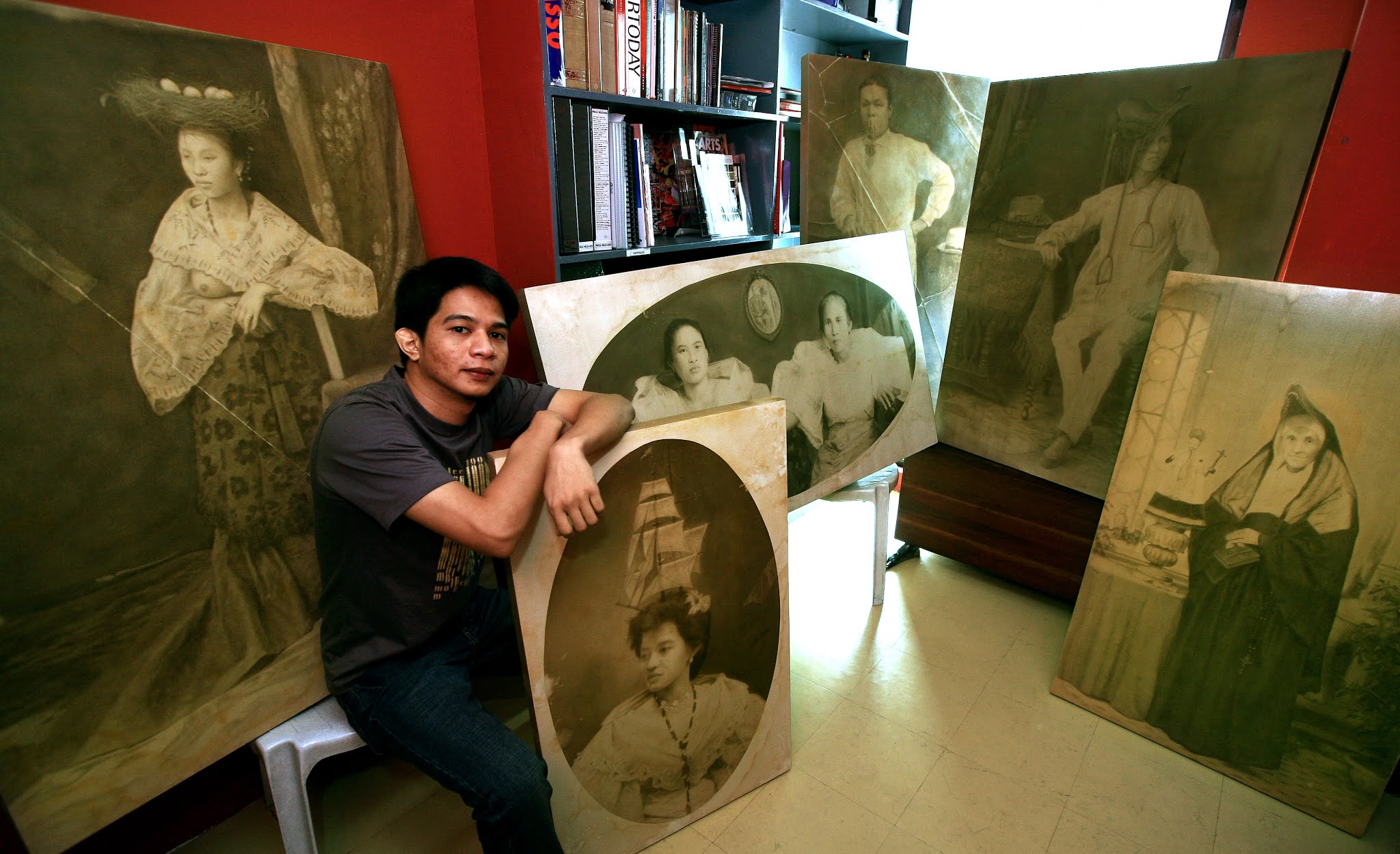
Turning over the pages of Filipino history is an adventure, and Joven R. Mansit, at his prime of 25 years, recaptured the decadence of the Spanish colonial era with the ingenious use of old photographs. But Mansit embarks on his historical adventure not with the usual romantic notions one gets when reminiscing about the past; no, Mansit also calls attention to irony and tragedies along with the glories of the past. And it is with this cynical view that Mansit translated his creativity and fascination for Filipino history into alluring yet perplexing works of art.

Most people might mistake his paintings as merely blown-up photographs, and this is probably indirect praise for the artist’s talent. Mansit pays tribute even to the most miniscule detail. Blotches, cracks, and scratches which are often considered damage in photographs are made beautiful and almost necessary additions in Mansit’s paintings. Only true connoisseurs of art will appreciate the attention Mansit has devoted to these details, thus creating the illusion of an authentic old and faded photograph. 

Mansit’s tragic interpretation of the past is an intrepid move on his part. The past brings along with it a complicated mixture of emotions, and most people hold on to their preferred emotions like children holding on to remnants of their innocence. But Mansit delves into tragedy with remarkable wit, and his sarcastic view of the past is also interlaced with humor. Each of Mansit’s paintings has a story behind it. The “Casco,” for instance, features a man with a horse’s saddle on his head and hooves as feet. “It was debated then whether Filipinos should be considered fully human or if they were destined to be slaves,” he explains. “I placed a saddle on his head, indicating that somebody will sit on top of him and he will work as a horse, as a working animal.” The “Mimosa Pudica,” on the other hand, represents a woman with an exposed breast and a bird’s nest on her head. “I showed here the vulnerability of the people, especially females, during those times. The exposed breast signifies that they are open for abuse. Also, the bird’s nest on top of her head is up for picking, and you know that the egg represents the wealth of the bird. Taking it would be like taking the bird’s wealth. It is very much like our natural resources then,” says Mansit. And the “Perla del Mar” is Mansit’s view on Western colonization. Mansit says, “The elegance and beauty we see in these photos is the effect of colonial mentality. In “Perla del Mar,” I placed a sail on her head to represent the Galleon Trade. The Galleon Trade is a symbol of elegance, but it also has an objective correlation to slavery. Can you imagine just how many slaves they placed on the Galleon?”

With Mansit’s works, both terror and melancholy weigh each other down in a balancing act – ultimately though, it is the viewer’s opinion that will determine which characteristic plays a more important role. And this is just the reaction Mansit hopes for. “I believe that the true purpose of paintings is to disturb. When people look at my paintings, I want to touch their emotions. I want to change their perspectives, and I want to give them something to think about.” Mansit’s clever approach to art draws on his childhood days. “When I was a child, I was fond on doodling over advertisements. That’s the main idea of my paintings. There’s already an existing material, and I would simply intervene and change one’s perspective about that material. It’s a manipulation of shared symbols,” he explains. His art manipulation might be deemed twisted, but nonetheless, it is undeniable that his art is everything he has aspired it to be: contemplative, complex, and definitely disturbing.

“Camera Obscura,” literally meaning “dark chamber,” will feature Mansit’s photography-inspired paintings and will be his first one-man exhibition. This runs until October 15 at the Boston Gallery, 72-A Boston St., Cubao, Quezon City. For inquiries, you may contact Britania Art Projects. Check out their website at www.britaniaartprojects.com.

Sacha Cotture


Unlimited Soul
Sacha Cotture digs deep for inspiration 

April 17, 2017
By Hannah Jo Uy 

 “In letting yourself explore,” says Sacha Cotture, “you can reach unexpected places.” 

In the old adage “trial and error,” Cotture places greater emphasis on the importance of “trying” over concerns on possible “errors.” It is of no surprise that an aura of sincerity prevails within the artworks of the painter. The canvas serves as a safe platform. In this space, in which his extemporaneous outpouring of emotions is reflected in dramatic silhouettes, there is complete detachment from judgment. His artwork is distinguished by its ability to relay raw intent. Every piece says so much by saying so little and each work stems from the artist’s pursuit of an intimate connection and self-understanding. In essence, his artworks are a visual representation of the highly-regarded eastern philosophical concept of “flow.” 

Growing up surrounded by the idyllic snow-capped mountains of Switzerland, Cotture’s interest in art started at the age of 12 when he found himself deeply touched by the works of Swiss painter, sculptor, and print maker Alberto Gicometti. “The way you can penetrate into his paintings moved me,” recalls Cotture. 

Though he indulged his love for the visual arts, he was not able to pursue it full time. “Where I grew up, it was not an option to become an artist,” he says. Instead, he became an architect. For many years, he channelled his creativity toward notable largescale and mixed-used developments across Europe, Asia, and the Middle East, but he found himself exploring ways to break free from the rigidity required of his work as an architect. “I started to paint late,” he admits. “But I believe it was inside of me, always. During my architectural studies, historians and teachers shared their love for art and its history.” 

Deeply fascinated by Japanese and Chinese masters, Cotture explored the material in what came to be a modern assimilation of an ancient visual tradition. The painter was enamored of a people and a culture halfway across the world, and felt a strong special kinship with Asian ink painting, which would play a dominant role in his creative process. 

“Calligraphy is an extension of nature and its forces and hence, in my opinion, boundaries should not apply,” he says. “What attracts me most to this very simple material [Chinese ink] is that it is very liquid and without textures. We are able to create and reproduce very rich patinas and other natural elements.” 

His deep appreciation for the East eventually led him to move to Hong Kong, and as part of his commitment to further pursue his art, he later moved to Manila, where he now resides. 

Though he is heavily influenced by Oriental aesthetics, Cotture takes special care to tread carefully and ensure that inspiration does not lead to appropriation. He added that in this ever-more connected world with massive amounts of information on classical traditions and on art widely available to the public, artists must ensure that the voice they are cultivating is theirs and theirs alone. “When I paint, I try to be inside of me and set external influences aside, including all that I have studied, all the images we are bombarded with these days. I find my inspiration inside and what surrounds me. Social media and the Internet can influence and limit your natural, inherent sense of creation by limiting your spirit to established works and images.” 

Cotture continues to juggle both disciplines, letting the contrasting nature of art and architecture strengthen his love for spontaneity and freedom. “[In architecture] every project, along with the products, is developed as a result of a long process. These products have to be efficient and in tune with the market. As we spend so much time on it, we try to conceptualize [in order to] reach a single theme or expression per project,” he says. “But when I paint, I have the freedom to try many things without any constraints. I have to say that this freedom to experiment is changing me as an architect and as a man.” 

Cotture’s journey as an artist serves to document his spiritual explorations. “The more I grow as an artist, I realize my works are becoming very simple in expression. Compositions are, in a sense, becoming secondary as the effort is spent on impressions and feelings. This work is generally done through textured effects, effects that we again find present in nature. There is also a greater appreciation of the material I use to paint, discovering and learning the matter—and letting [it] speak on its own.”
 
Cotture celebrates the vibrations of nature through paintings that showcase elegant, minimalist yet deeply moving elements in broad strokes. This is most expressed in “Moments de Creation,” his latest exhibit, which was unveiled to the public early last month. 
The 18-piece collection explores the concept of time as each work serves as a frozen record of creation. Most important, the exhibit continues to showcase Cotture’s drive toward knowledge. “I believe that we have, in us, many more memories, feelings, and sentiments,”
he says. “I try to let all of these things express themselves and [in doing so I] realize that all of it is natural and in tune with the elements.” 

‘Moments de Creation’ is currently on display at Galleria Duemila 210 Loring St., Pasay City

Ernest Concepcion


Ernest Concepcion : Full Circle invasion

Clever mind, a skillful hand and an oversized funny bone. These are just a few of the attributes of New York based artist Ernest Concepcion. Another thing to note is his skillful ability to execute thought-provoking works that vary from installation pieces, videos, paintings, and anything else under the sun that requires a combination of flair and creativity.

Ernest Concepcion is a creator more than an artist. Creator being a more fitting word for his occupation, simply because his mind cannot be contained by mere brushes, canvas and any other such mediums. Instead he occupies his time challenging the idea of what is, in fact a medium. Breaking out of the confines of traditional art forms, his early works were dominated by a hunger to explore and push the boundaries of the definition of art ironically through tributes to great art. And now, with his first one-man show, “Puso + Daga," being exhibited at the West Gallery, he has gone back to his roots in every sense of the word.

Oddly enough, this widely exhibited painter never sought the recognition and success he has garnered. “Even when I was in school, I never thought I could continue doing it.

I thought I’d have a degree, and then get a day job, I never thought it would be a career because I just loved it too much. I was having so much fun working on it." However, like the name of the famous coffee shop of the city that he has called home for the past 10 years, serendipity happens.

Born and raised in the Philippines, the young artist recalls his early interest in art along with his older brother, “As a kid, I used to draw with my brother…he was able to expose me to a lot of good movies in the '80s. We loved Mad Max, that’s how we learned how to draw cars. Doon ako nagkaroon ng fascination with just building stuff.” 

This fascination eventually led him to the University of the Philippines in order to get his Bachelor in Fine Arts where he graduated from in 1999. Majoring in Painting, he cites many well-known artists as both his contemporaries and mentors, all of whom have proven to be strong influences in his early stages of exploration, “It was a great phase,that was the time I was reading a lot of books on theory. My teacher, Jerry Tan exposed us to a lot of artists essays, so we were kind of very heavy theory based work. It was a lot of art history…When I was in college I didn’t actually paint a lot, we were against painting, we were painting majors but we went beyond that, we were doing video work that had some paintings in it, we were exploring other avenues.” 
 
Upon graduation, diversity was the name of Ernest’s game. Embarking on many mediums he relates numerous involvements in the art scene through hi s enthusiast i c participation.“I even  set up an independent record label called dokyumento records, which I got from a grant f rom the NCCA, so I was recording bands, so I was really doing so much stuff after ’99 in here, actively, creatively.” 

Despite exhibiting mostly nst a l l a t ion based work, certain elements have beguto present itself as a recurring theme in his works, s p e c i f i c a l l y that of his signature move of  injecting subtle humor into his works.”I was already working with puns, kind of humorous na din work ko before eh…back then were conceptual but they were also humorous, slight comedic nature.” 

Aside from that is also his interest towards using language as a tool to create a new meaning from the while picture and be seen as an element of a sentence. ‘Naging works ko din ang quotation marks…I built these paintings in the shape of quotation marks, it was a cut canvas and giant quotation marks, and everytime may group show I would install my work on both ends of the show, so when you look at the show, it would seem like my piece, kasi parang quote/unquote" ko yung buong show.”

This need to push the boundaries of the ordinary took Ernest farther than he thought, specifically to the city that never sleeps. “It got too small for me, I wanted to do so many things. So I took that challenge to go to a highly competitive environment, which was New York. “

Ernest migrated in 2002, needing nothing more than a portfolio of his works and his determination to challenge himself and explore. However, with the expensive fees of equipment compared to here, Ernest 's technology based installation worked suffered greatly. Nonetheless,this suffering bore fruit to another era in Ernest’s artistic life: Line wars. 

Line wars,” is a wonderful display of tension and dexterity. A collection which amounts to over a hundred works of ink on paper, it marks the beginnings of his new artistic persona. "I was kind of in a sleepy town in Jersey, in a small apartment and that’s how I decided to become a kid again and start drawing these small works on paper…my brain was kind of clamoring to express itself… it was saying do something, so yun yung naging outlet ko. In fact yung f irst drawing ko is squirrels vs. ants eh, c o z t h e r e were a lot of squirrels in Jersey and a lot of ants, so I had them battle it out in a small drawing.”

Although this series continues to explore other aspects of tension and conflict, it is through an interesting turn of events that led to the rise of Ernest’s fame among the artist’s circles. “One of our friends who was a curator, decided to have a show...The theme was apocalyptic, like Utopia…I said ‘oh, I have this video of us threeFilipino  astronauts in the kitchen, would that work?’ She asked, 'what has that have to do with the end of the world?' Sabi ko sa kanya, if you start seeing Pinoys in foil astronaut suits, I think that’s a sign that this is the end of the world. So she started laughing and included that piece in the Bronx."

The video was included as an installation piece, and caught the attention of Melissa Chiu, who invited Ernest. And after having seen Ernest’s work, she went on to display his own personal works on the main wall, an event that he considers to be one of
the biggest catalysts in his career.

He went on to multiple group shows, with 2008 marking his first one-man show in New York City. At this time he had already begun to experiment with color, in which the medium also battled each other as is normally seen in the conflict within his painting. Even more so his interest in space, by asserting his invasion of it through each of his shows. "I like the subversive aspect of it. Di lang ako nagpapakita ng trabaho; I'm  kind of like infiltrating your space.”

It is no surprise, then, that this latest exhibit at West Gallery manages to bring together this element of tension, humor, invasion and playful innocence with a distinctly Pinoy stamp. “Puso + Daga” is a colorful display of “conflicting chat speak and biblical images…It’s still humorous…Patawa pa rin. And the flashy colors.. the text. So it’s a tribute to that. And also sa mga jeep, I want to get back to that. Interesting dito yung enamel paintings....a lot of people thought that yung enamel medium is a medium that I’ve been just working on, but the funny thing is the enamel paintings started even way back when I was still in school… pre line wars phase. And since this my first solo show sa Pinas, I wanted to do an homage to my roots. When people heard I was gonna have a show here, they thought I would show a New York kind of work, I wanted to do something so Tagalog, so Pinoy, it's sort of a tribute from where I came from…I still want to involve elements that kind of don’t really make sense. But at same time you kind of make sense out of it. Something you wouldn’t expect.”

Truly a master of the unexpected, the only thing that we can safely assume is that many clever jokes and moving images are yet to be unveiled.

Henry Cainglet


Henri Cainglet: Defying the norms and changing art’s form
 
April 18, 2011 / E-2 
Text by VINCE G. LOPEZ 

It is the constant chang­es that occur in life that make life more interesting. 

While some strug­gle coping with the changes, visual artist Henri Cainglet embraces change to further improve his already impressive art works. 

“Being an experimental artist, I don’t stick to one media alone. I easily get bored doing the same thing over and over again. I strongly believe that constant change enhances my personal development and artistic creativity,” explained Cainglet. 
Creating Complexities 

Raw materials from the usual places are turned into exquisite art in the hands of Cainglet. But it’s not the usual sculptures or the com­mon depiction of beauty that made this artist stand out in the indus­try. 

As a matter of fact, it’s how he defied the norms and how he challenged the depiction of art that caught the critic’s atten­tion to his works. 

“I always try to be original as much as I could. This way, my works will get eas­ily noticed. Like when I first exhibited soft sculptures at Ayala Museum in 1995. That’s where I was first noticed with a nice review by critic Cid Reyes and Alice Guillermo,” shared the art­ist. 

Art critics are enamored on how Cainglet uses raw materials and turn them into revitalized ones. It is the innate talent of the artist that allows him to create an enigmatic work of art which can come from scraps of wood, shells from his travels or a vision from his imagination. 

“Doing both abstract and figurative works always fascinates me and by injecting them with something Fili­pino or by being an Asian artist gave me some satisfaction and fulfillment,” said Cainglet.
 
Raw, Thaw and Figures 

Hailing from Bohol, Henri Cainglet started his passion with the arts at an early age. It was during his grade school years that he first dabbled with colors and figure. According to him, his passion for the arts might have come from his grandparents who were also inclined in the arts. 

“After two years in college taking agri-technology, that’s when I realized fine arts is my vocation and started tak­ing art lessons under Fernando Sena, the late Ray Albano, Phyllis Zaballero, Dick Daroy, to name a few,” relays Cainglet. 

“I started as an artist profession­ally in1985 via my first one man show at Hilton Art gallery owned by the late Virginia Ty Navarro, sculptress of the famous EDSA Shrine. In fact, she was the one who discovered me,” added Cainglet
Taking an entirely different course of life from the course that he took in college contributed to how Cainglet approaches his art. His sculptures, paintings and depictions of beauty and life are deeper than the conventional arrangements and colors or traditional art. 

Art critics describe Cainglet’s work as something that not neces­sarily comes from any specific school of thought. They are neither abstract expressionism nor abstraction. It is through this process that the artist is able to come up with impressive and enchanting visual art works that engage the viewer’s senses as well as perception.
 
Experiences and Experimentations 

As an experimental artist, Cainglet dabbles on various media and strays away from repeat­ing himself when it comes to his series of works. 

“My favorite medium is acrylic and the use of indigenous materials. Themes of my artworks depend on my moods and I have to see to it also that I have never done that series before,” explained Cainglet. 

The artist further explains by saying, “Most of my artworks were inspired by my culture, in my being a Filipino, my travels, dreams and futuristic ideas. They convey mostly hope, changes, and environmental concerns, among others. Specific themes vary from year to year, tackling street vendors during the early years, to European travel series including Art Against AIDS shown in 1993 at the Cultural Center of the Philippines.” 

But it was back in 1988 that Cain­glet had one if his memorable experi­ences as an artist. It was back then that Cainglet received an offer to study at Sonoma State University in Califor­nia to learn more about art. 

It was a defining moment for the artist not only because of the chance to further im­prove on his already wonderful works of art but also a sign that his works are getting world­wide attention. 

Indeed, his works have become interna­tionally acclaimed as he recalled another de­fining moment in his career.
 
“Another memorable experience was during my solo show at the Na­tional Gallery of Malay­sia of the same year. The Prince and Princess of Malaysia opened my show where they arrived on a Rolls Royce with the red carpet starting from the gallery up to the car park,” recalled Cainglet.
 
“Being an international artist and having exhibited in New York, Seattle, San Francisco, Oakland, Amsterdam, Berlin, Vienna, New Delhi, Brunei, Singapore and Malaysia made me proud. My experience proved to the whole world that a lowly artist from this side of the planet can make it anywhere no matter what,” concluded Cainglet. 

Paz Abad Santos *


Allan Cosio *


Roque Lee aka Roxlee


Roque Federizon Lee: A Little Humor Goes A Long Way

Nov 22, 2010 / F-2
Text by Bryan Garcia

Cesar trudges up a steep hill. He huffs and puffs and works up a sweat as he slowly labors his way to the summit. Cesar is shocked to find out that the trail he was following doesn't lead to a breathtaking view, instead it comes from a giant roll of tissue paper belting out ply after ply of the soft paper.

Everyday situations intertwined with absurd ideas that create an elemet of bizarre humor. These are the creations of visual artist, cartoonist, indie filmmaker and animator Roque Federizon Lee, commonly known among his peers simply as Roxlee. Together with his brother Mon Lee, this artist made his name with a daily comic strip entitled " Cesar Asar".

Roxlee's transition through different modes of artistic expression was a gradual progress that arose from the purity of his love to create. Growing up in Naga City, Roxlee was enamored by the magic of comic strips by famous cartoonists like Larry Alcala and Nonoy Marcelo. "It all began with comic strips. I just made funny drawings and it all started from there, " Roxlee shares.

Roxlee the Cartoonist

Roxlee went to Manila to study architecture at the National University. However, he chose to forego college to focus on his already existing stint as a cartoonist for Jingle Magazine. "By that time, I was already in love with comics. It was far from what we did in architecturewhere straight lines were really the focus," the artist recalls.

Whilw working on his strips for Jingle, Roxlee formed the initial idea for his strip "Cesar Asar." "The idea for the character of Cesar Asar came from a real person from our hometown in Naga. He also had a similar mustache as well as the other features of the character," Roxlee shares.

From as early as 1980, Roxlee was already contributing Cesar Asar comic strips to Manila Bulletin, a stint that would span for two decades. This sequential art is more or less an extension of the artist's personality. From the witty twists, the loosely composed figures and the satirical plots, Roxlee illustrates the plight of Filipinos with humor.

The artist admits that keeping up with a daily strip was a challenging endeavor. "It's difficult to sustain ideas for that long. However, ideas have a tendency of reproducing. When you start on something, it just grows by itself," Roxlee says.

Roxlee the Animator

Aside from his consistent comic strip contributions, Roxlee also ventured into animations, establishing a name as one of the pioneers in independent filmmaking. This transition came about as a natural progression from his craft. "It started because there's always an urge. If you make comics, the tendency is to make it move. I feel like something is lacking if they don't move," Roxlee shares.

Roxlee's journey towards filmmaking and animation started in 1984 with "The Great Smoke". The film was a combination of stop motion two dimentional illustration combined with photos and images gathered fron books and other materials. The six minute short film was tied together by a musical score done by a band called Elemento specifically for the project.

Using super 8 films to render his works, the artist filmed, illustrated and edited the work on his own. Working on a shoe string budget, Roxlee even reveals using expired films to cut costs just to get the project done. "During that time I couldn't find any one who was willing to help so I deed everything on my own, I just had to satisfy my lust to create," Roxlee recalls.

Among the short films that brought recognition to Roxlee was his work on "Juan Gapang" which won for him the Gawad Urian award for Best Short Film in 1989, and his film "Tito's Wedding which also won for him the Best Short Film in the 1995 Metro Manila Film Festival. "I like film and animation because they involve multi-media. You can produce whatever you want with it," Roxlee shares.

Although the independent film scene has picked up, it was far from what Roxlee and his peers had to deal with during their indie filmmaking days. "The challenge then was getting an audience for your work. We showed our works at bars and sometimes even at a friend's garage and we were the only ones watching them." Roxlee recalls.

However, the artist appreciates the hardships they went through because nowhe can see the fruits of their labors being harnessed by the next generation. "Indie filmmaking for us back then was loike climbing a mountain. We were armed with bolos and carved our way into the forest to make a trail for future generations to use," Roxlee says.

Roxlee the Painter

After Roxlee's comic strip discontinued in 2000, the artist has undergone another transition, this time to the more conventional medium of oil paintings. Similar to his works in sequential art, Roxlee maintained the graphic images that he is used to manipulating and rendered them to his new medium.

Roxlee preserves his comical orientation by painting situationsthat revolve on social commentary hidden under the cover of wit and humor. Much like his cartoons, the artist uses elemets that when juxtaposed create a surreal world often reinforced with dialogues to emphasized the weight of his works' message.

Roxlee has established himself as one of the true icons in the local art scene.  His contribution to the comic world has helped the industry evolve in such a way that enabled young artists to see the freedom and the simplicity of purveying an idea through drawing. Likewise,his ground-breaking works in animation have opened up doors to thousands of aspiring artists looking for a fresh and versatile mode of self expression.

Although the artist's plight has been far from pretty, there is one thing that is indespensable all throughout his career. "You always have to have a sense of humor while working, otherwise it's going to be very difficult," Roxlee says.


Jerome Choco

CHOCO’S RHAPSODIES  By Sara Grace C. Fojas December 30, 2019 / C-3  Multi-talented young art­ist Jerome Choco likes to express his love for ...